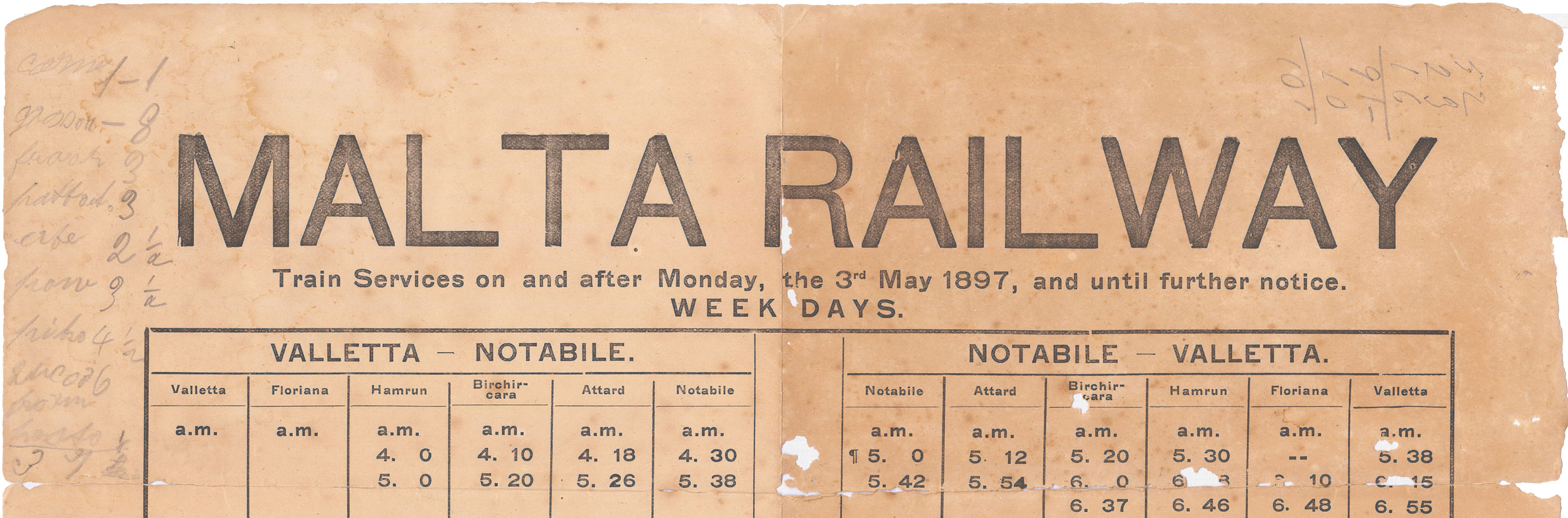
Over the last month a number of early Malta Railway Timetables have come to light. Three dating to the time of the original Malta Railway Company were published originally in Italian language newspapers. Another, the most historically significant, comes from 1897, when the railway was Government run.
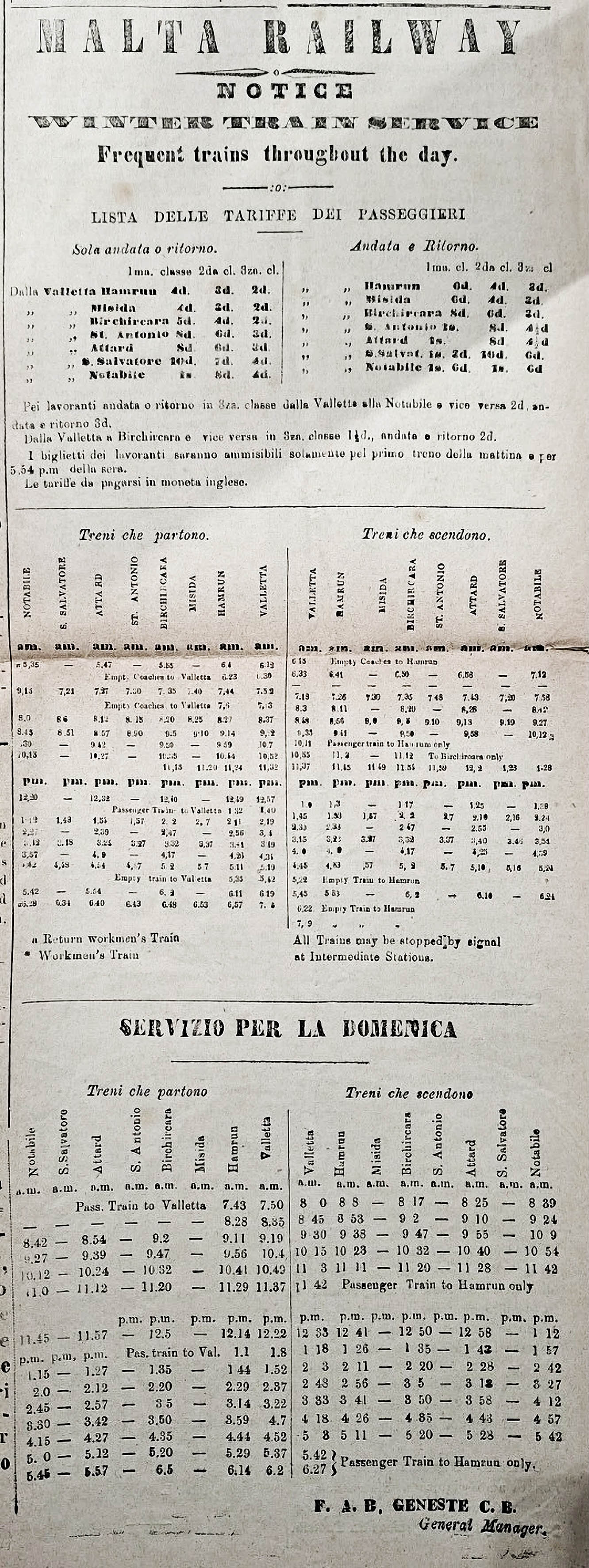
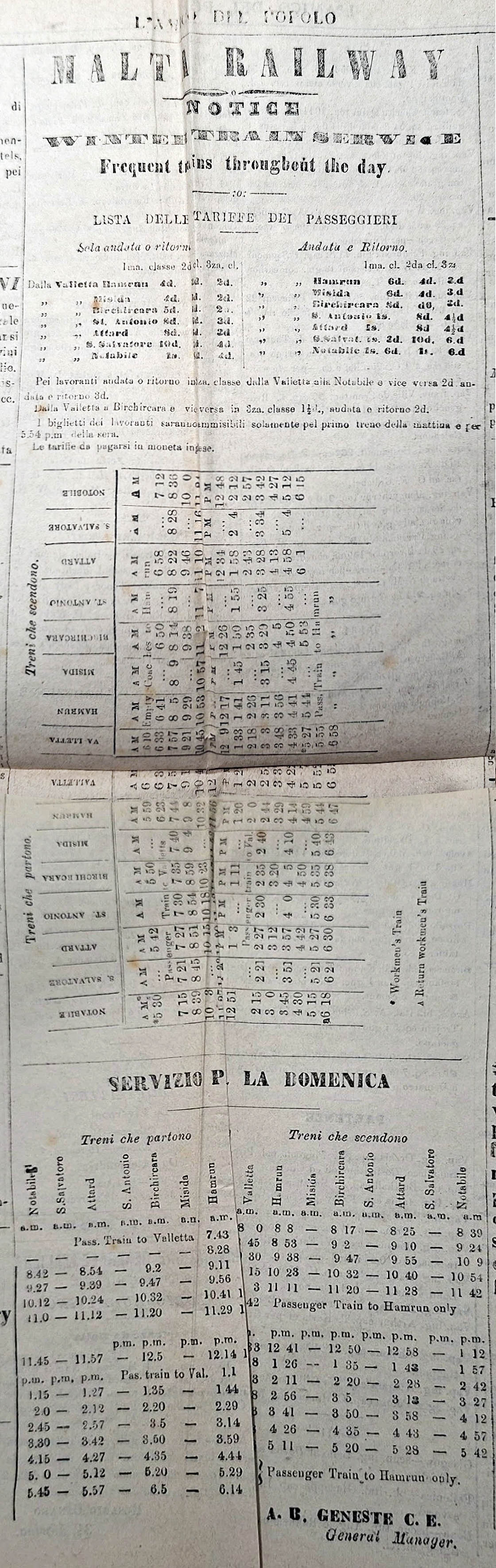
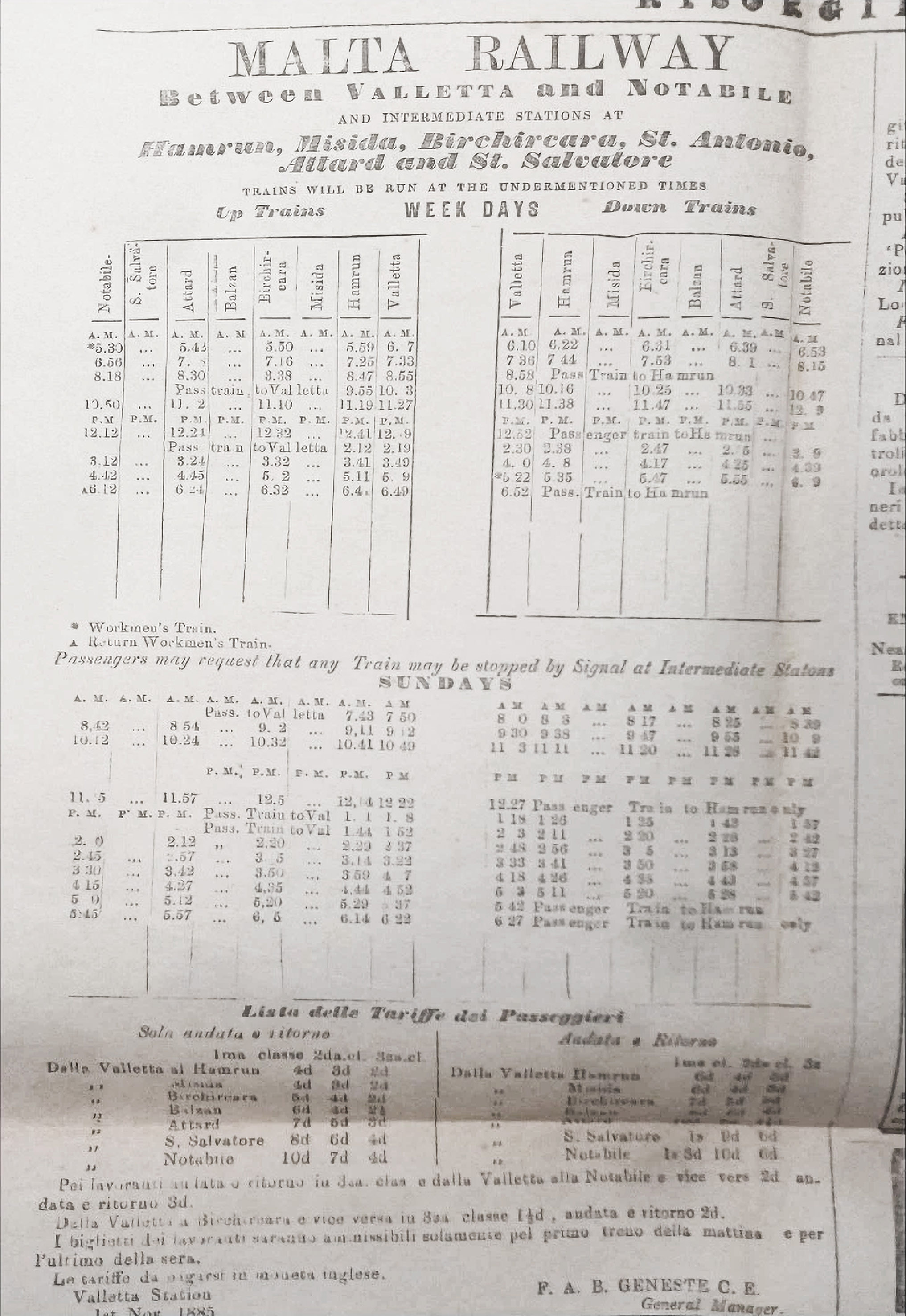
The first three are, coincidentally, all winter timetables, for the season 1883-84 1884-85 1885-86; happily consecutive. There are some noteworthy observations.
In 1883, the inaugural year, two trains operated throughout the day, running fourteen services in each direction over the whole length of the line.
An early morning workman’s train began from Notabile at 5:35 arriving at Valletta 43 minutes later. It the ran empty back to Hamrun where the purpose-built workmen’s carriages were swapped for the standard passenger rollingstock and the train run again as “empty carriages” to Valletta. Why these operational manoeuvres, unavailable for public use, were included on the timetable is very odd.
General services commenced from Valletta at 7:18. The first train operated throughout the day as a fast service not stopping at the intermediate stations of Msida, St Antonio, or San Salvatore. Trains generally took 39 or 40 minutes to climb to Notabile, no added allowance being given for trains with more scheduled stops. Astonishingly, only three minutes was allowed at Notabile to uncouple the engine, run it around the train and recouple before it was scheduled to return. Times were also tight for this manoeuvre at Valletta.
A second train began service at 7:06, again timetabled to run empty to Valletta before becoming the day’s second general service at 8:03. After two round trips it returned to Hamrun for more than three hours, allowing the other train to carry out off-peak services. There was another exchange of carriages timetabled with empty trains between Valletta, Hamrun, and back for the 5:45 return workman’s train.
Perhaps in response to lessons learned in the first year, the winter timetable for 1884-85 reduced the number of services to twelve. The second train only began running at 2pm. There was no respite for hard working train staff in reversing the train at each terminus in such quick time. The confusing timetabling of empty trains was discontinued.
The following winter season, trains had declined in number yet again, just eight services made the return trip to Notabile. The reduced timetable could be maintained with just one train in service; certainly more economical. We must assume that this was in response to passenger demand either falling away or never having met the Company’s original ambitions for traffic on the line.
These timetables fill a gap in our knowledge of how the railway Company operated until it became utterly unviable and Government exercised its right to revoke the concession and take the line into state ownership.
After services recommenced in 1892 the next known timetable is, serendipitously, the winter schedule for that year. A service of fourteen trains had been reinstated. Between this and the next of the recent finds there’s another five year gap in our knowledge.
The most important detail of the 1897 timetable is that it’s the first inclusion of Floriana station on any actual schedule of services, in fact the first mention of Floriana station since the opening of the railway in any documents so far uncovered. It is an important piece of evidence in supporting the theory that the underground station built ahead of the line’s inauguration was never completed (See here), services only commencing officially from a new station site built by Government in about 1895.
Unlike the earlier timetables published in newspapers, this version was intended as a notice for display at stations or other public locations. Sadly, it’s incomplete, but enough survives to establish that scheduled trains had increased quite significantly. Fifteen trains ran the whole length of the line, and six new services had been introduced serving only between Valletta and Birkirkara. The practice of running trains empty had been discontinued, all train movements now being fare earning.
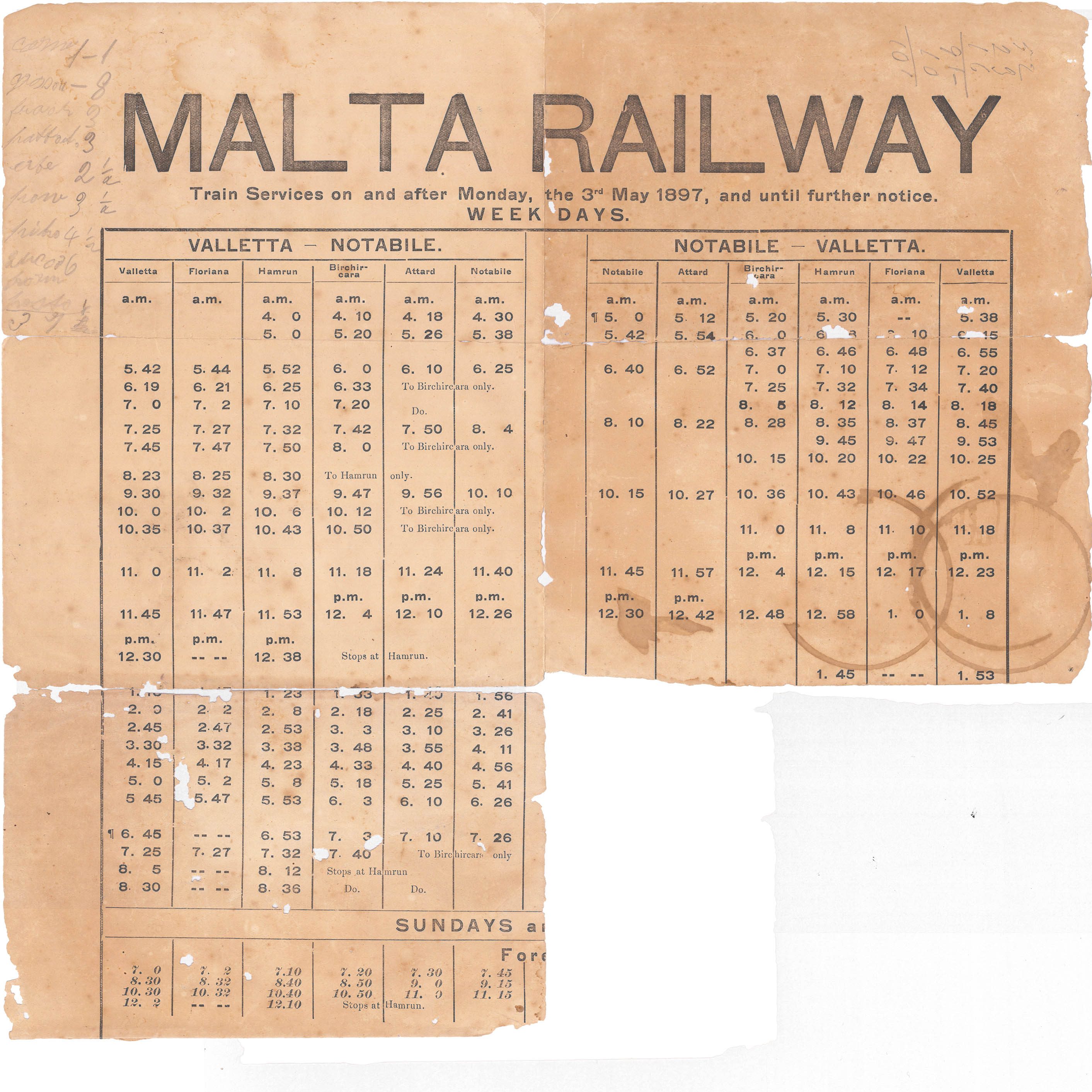
Services uphill to Mdina were scheduled at around 40 minutes and the time given to reverse the train had been marginally increased to a minimum of four or five minutes but occasionally a generous fifteen. The workman’s train languished at Notabile for half an hour, perhaps giving time for staff on the arriving service to open the station and begin selling tickets before the first train of the day to Valetta.
This timetable is, admittedly, for the spring of 1897; more trains would certainly be expected out of winter season. However, it illustrates a change in the structure of services, focussing on the most profitable part of the line to Birkirkara and Valletta, and reflects the known increase in use and profitability of the line at this time.

No responses yet