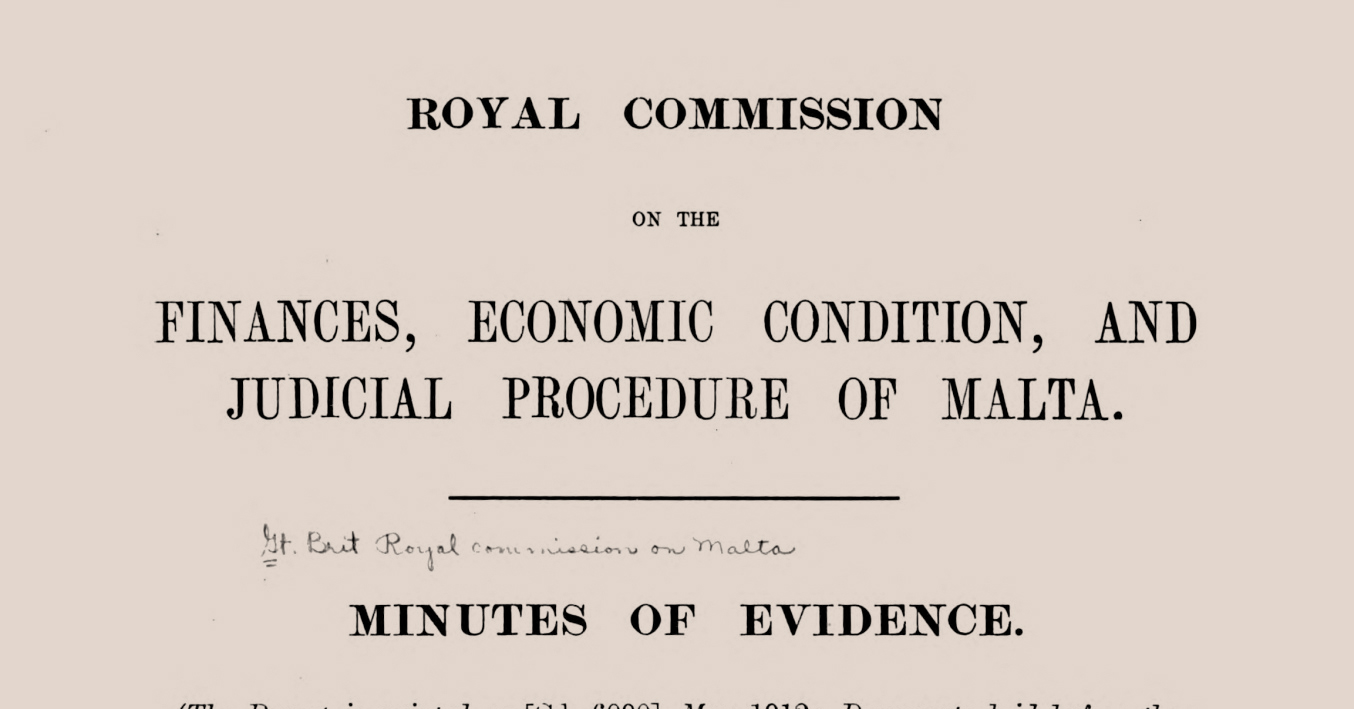
In 1911 the British Government imposed a Royal Commission on the island of Malta. It was tasked with investigating the finances, economical position, and judicial procedure in the country amid economic decline, budget deficits, and increasing unemployment.
Full minutes of proceedings were transcribed and published the following year, with the railway being a particular issue of concern. Many of the witnesses were called to account for decisions, particularly in regard to its acquisition, its extension to Museum, and allowing the tramway to set up in direct competition with it.
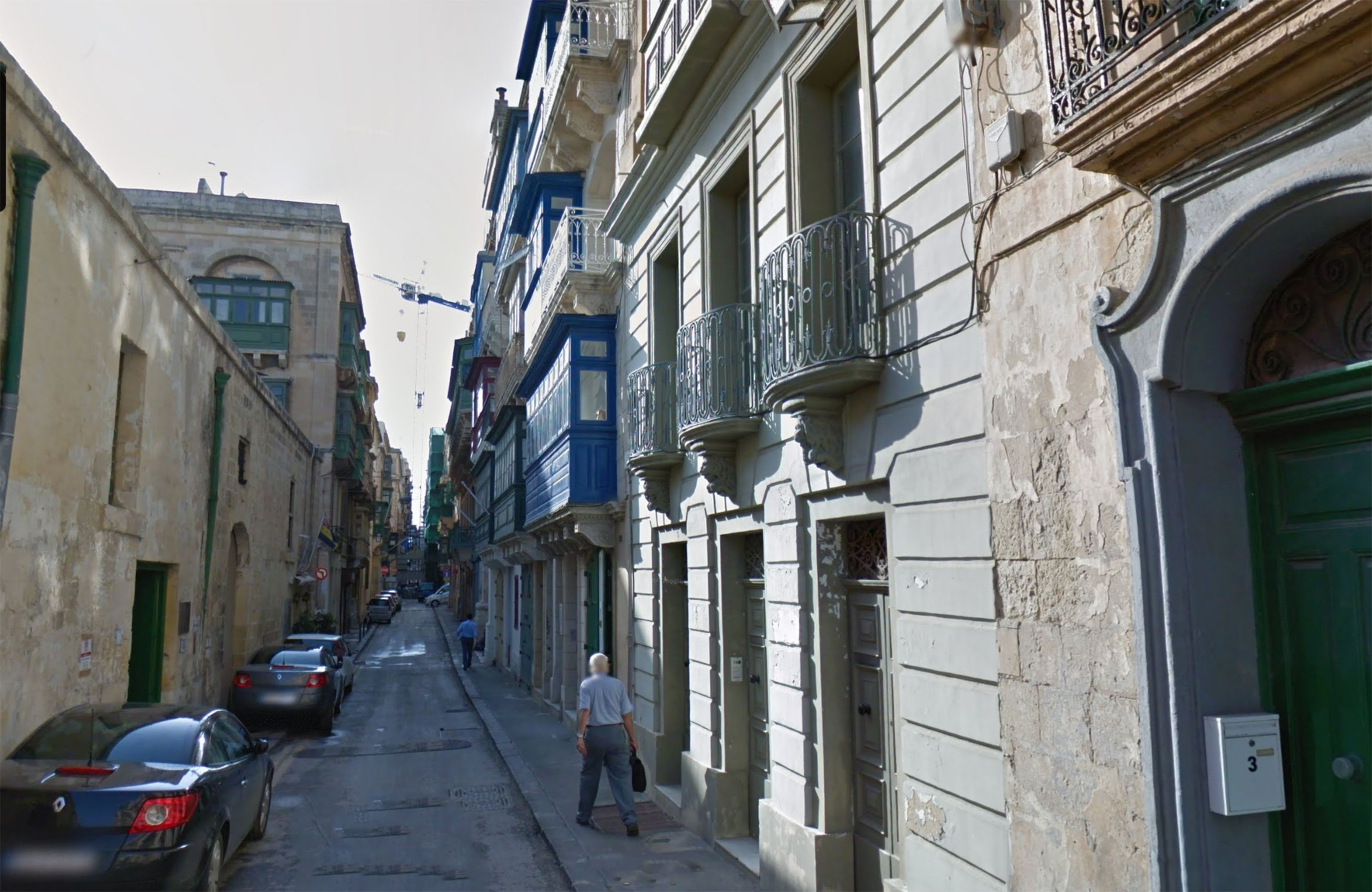
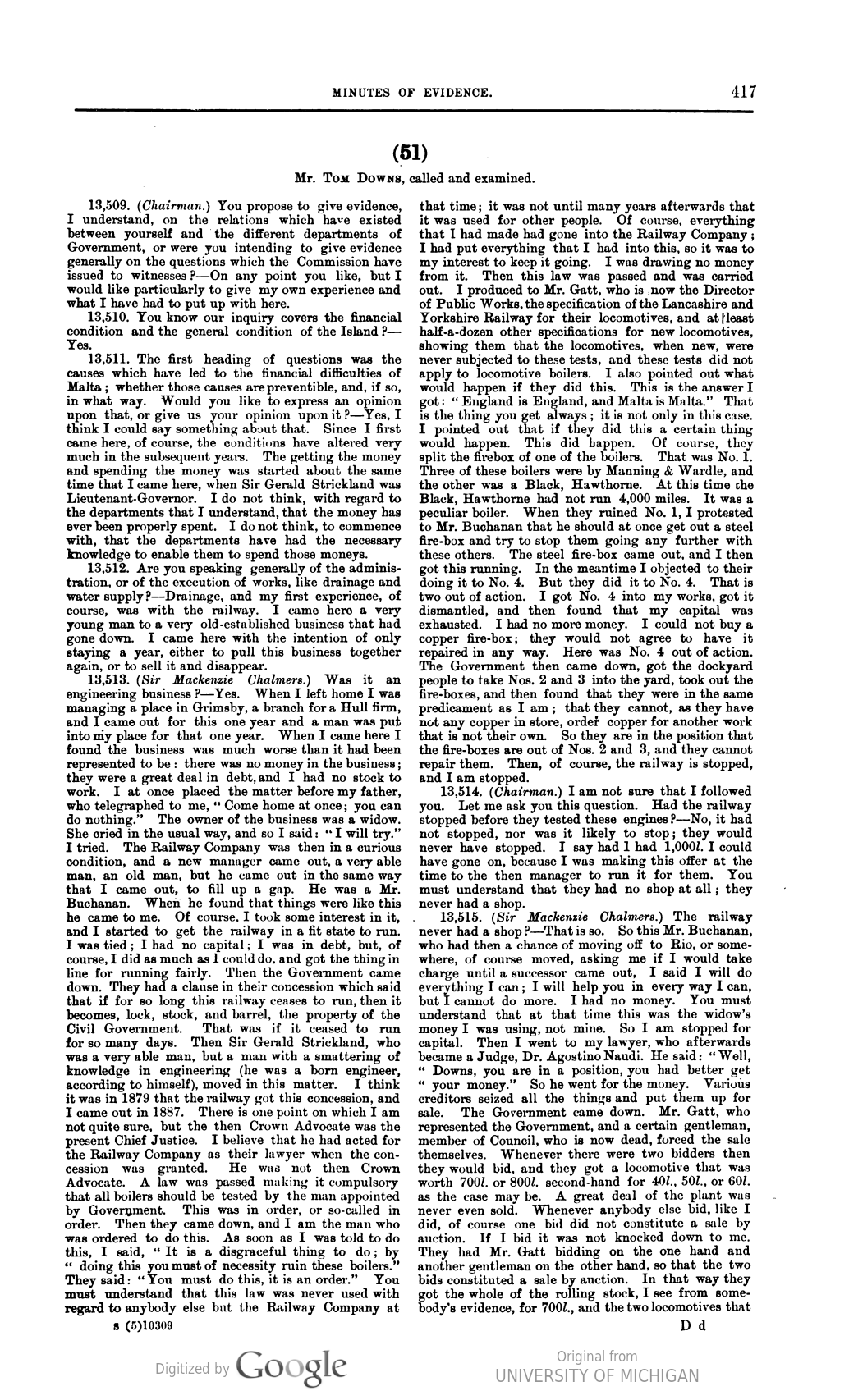
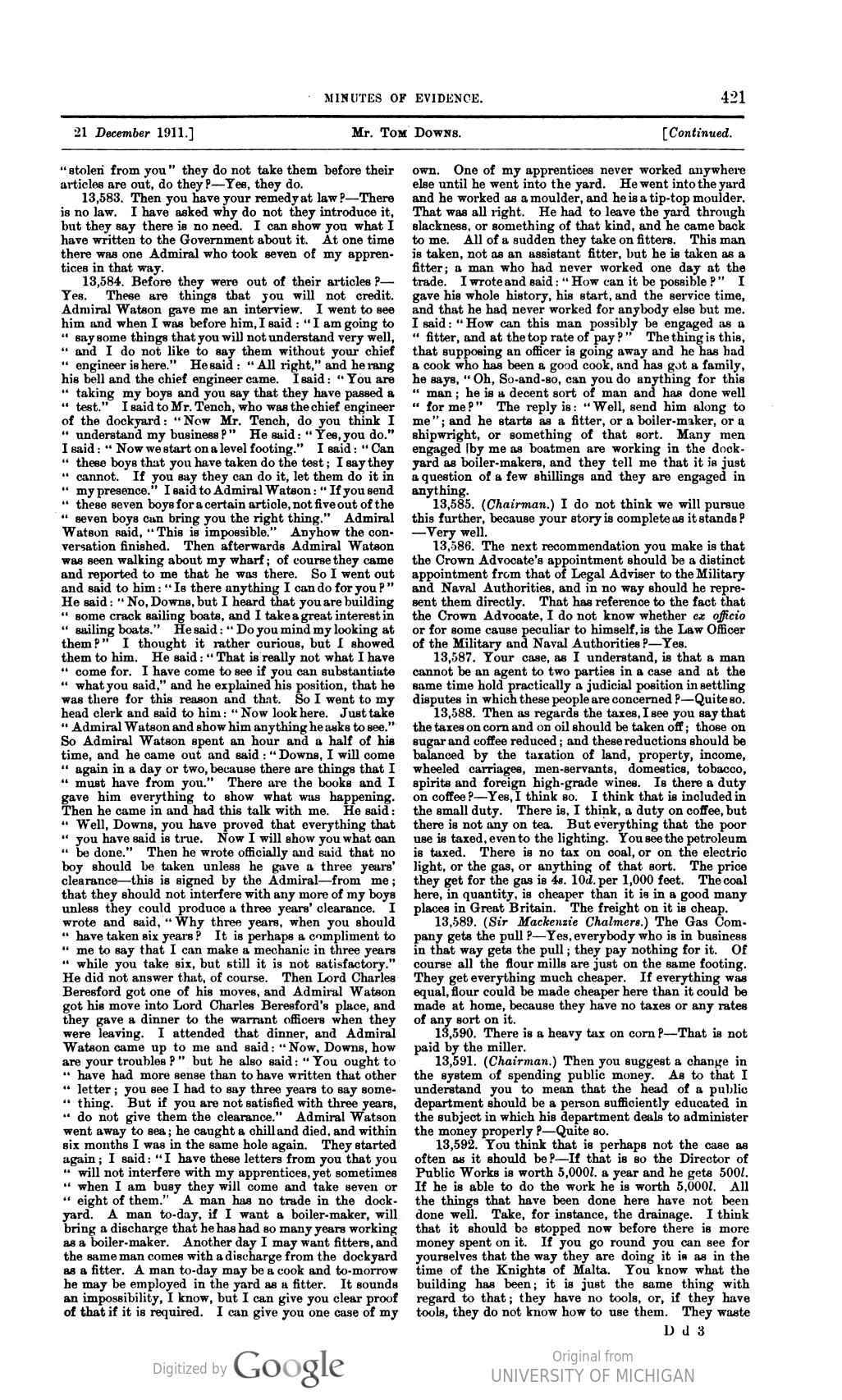
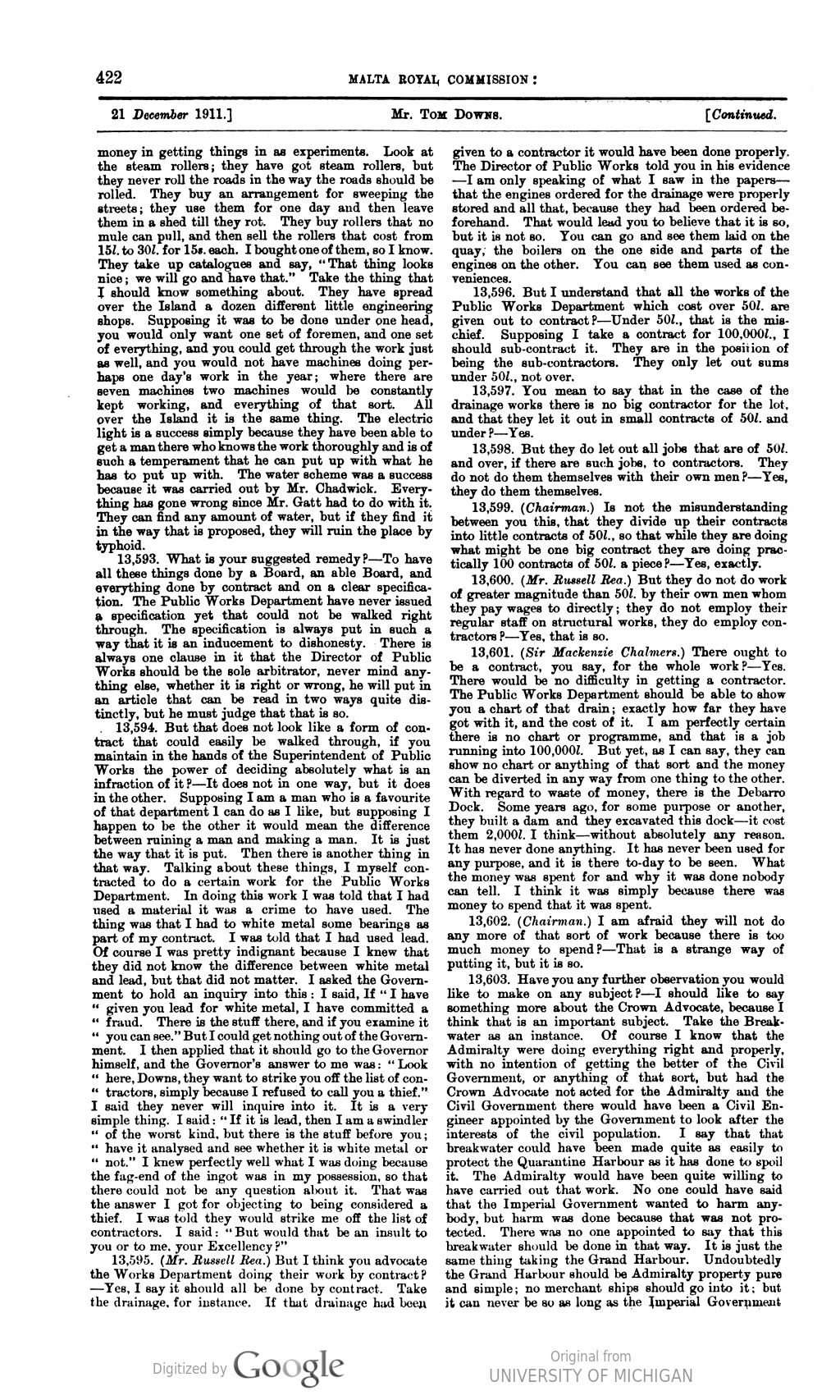
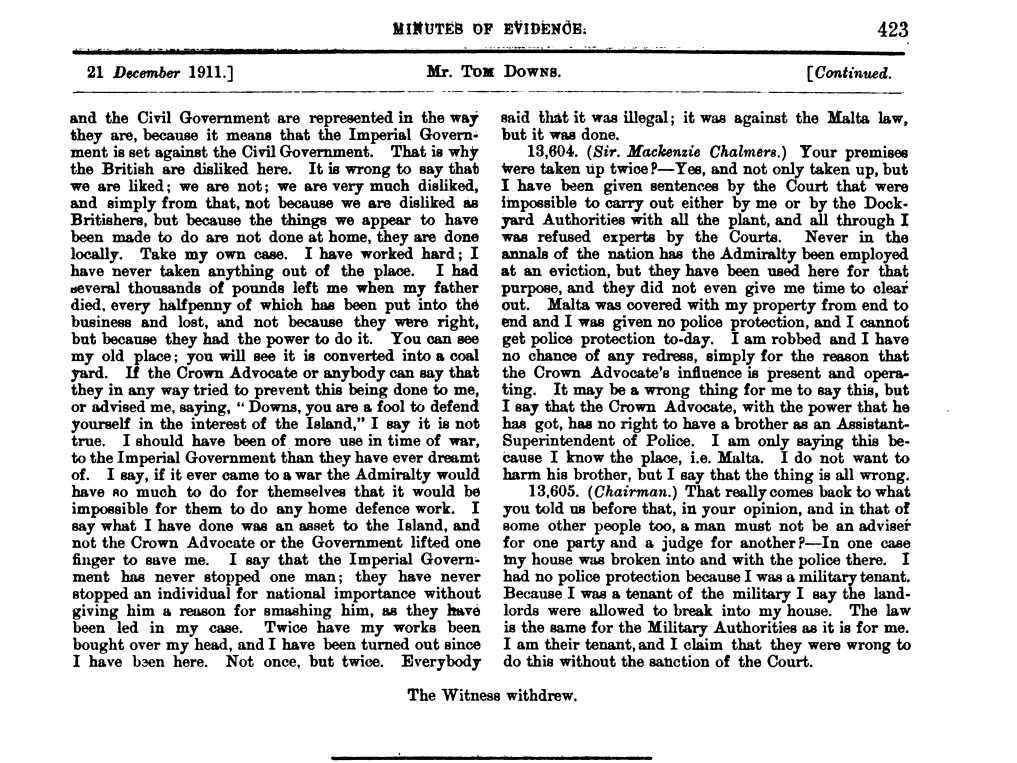
The evidence of many of these witnesses is interesting, but one is especially curious. A Mr Tom Downs had petitioned to give evidence to the Commission and was granted that opportunity on 21st December. He proceeded to tell the commissioners his story, one that began twenty-four years earlier.
Tom had come to Malta from Grimsby in 1887, to take up management of an engineering company on behalf of a widower, Mrs Horne. He involved the business with the Malta Railway Company when it was still a private concern. The manager, F A B Geneste had recently departed from the railway, leaving it in “a curious condition” by Tom’s account. A new manager, Mr George Buchanan, described an old man (54!) but “very able”, was sent from England in 1888 to “fill up a gap” and engaged Tom to put the railway in good order.
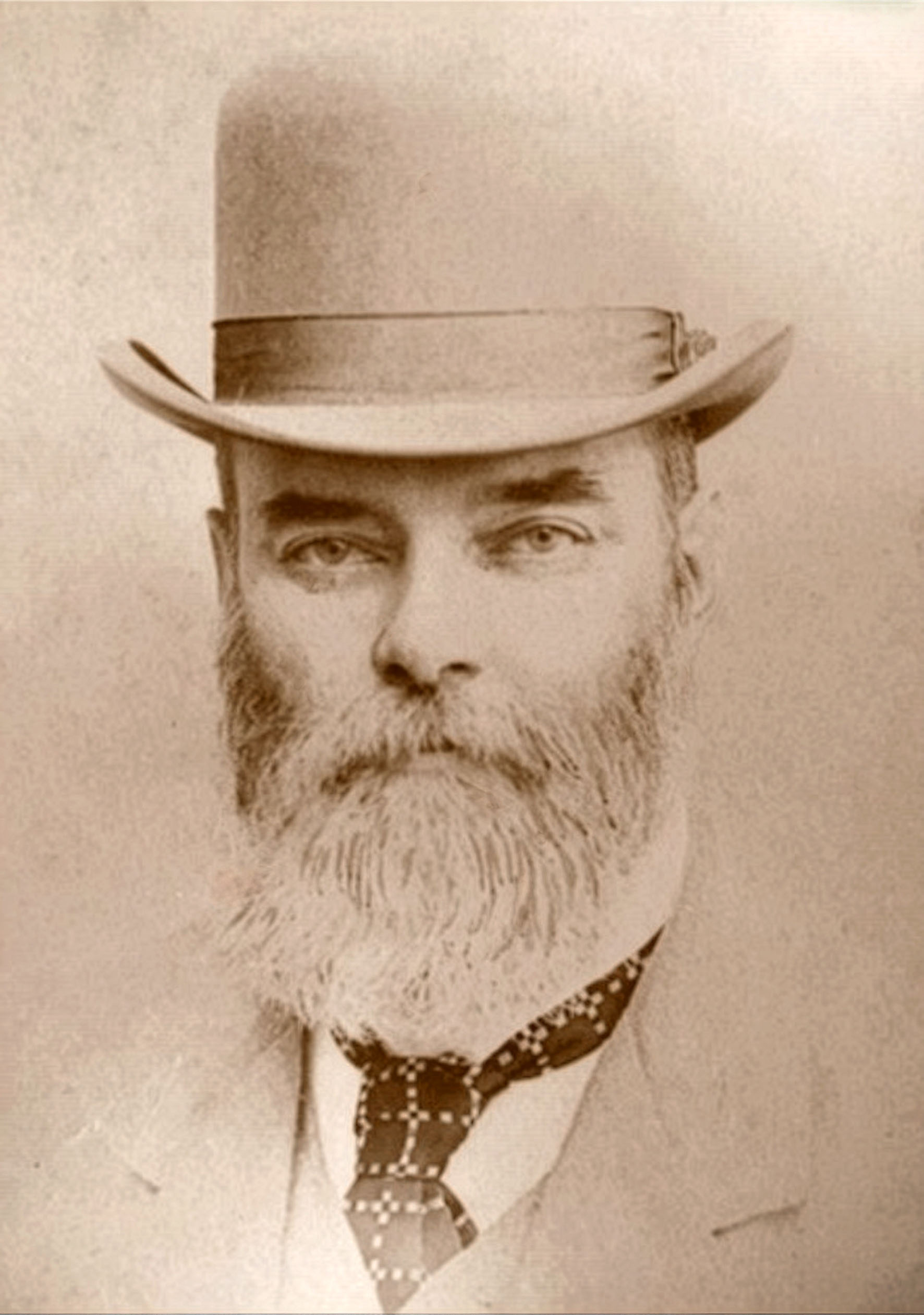
Buchanan was named as one of the engineers paid for work on an earlier railway scheme in 1879 along with William Roebuck. Roebuck later became a director in the Railway Company and it’s likely that Buchanan was also an investor sent out by the company to oversee the transfer to a new manager.
Buchanan stayed only for a very short time, leaving very quickly after his arrival, before the end of 1888. Tom recounts that he’d been asked by him to “take charge until a successor came out”.
Tom explained that he’d been asked by Lorenzo Gatt, at that time an officer of the Public Works department, to enact a recent law requiring boilers to pass strict new tests. His view was that the tests were excessive and were being applied punitively to the railway alone; his implication is that Government were acting in a deliberate way, one designed to ensure the Railway Company’s collapse, the defaulting on its obligations and the infrastructure being forfeited to the Government under the terms of their concession.
He claims the locomotive boilers were required to be tested at twice their working pressure, like those of marine boilers were; British practice tested railway locomotive boilers to 1.5 times. The firebox of locomotive boilers is different in design to those of ships boilers, having a more complicated form that had different design tolerances. Perhaps unsurprisingly, he reported that the boilers failed under this punishing testing.
Firstly, the copper firebox of Engine No.1 split. Tom says he replaced it for a steel one. This would have been more robust, but less efficient. The Boiler of No.4 he says also failed. He noted this was of “peculiar” design, supporting other contemporary descriptions.
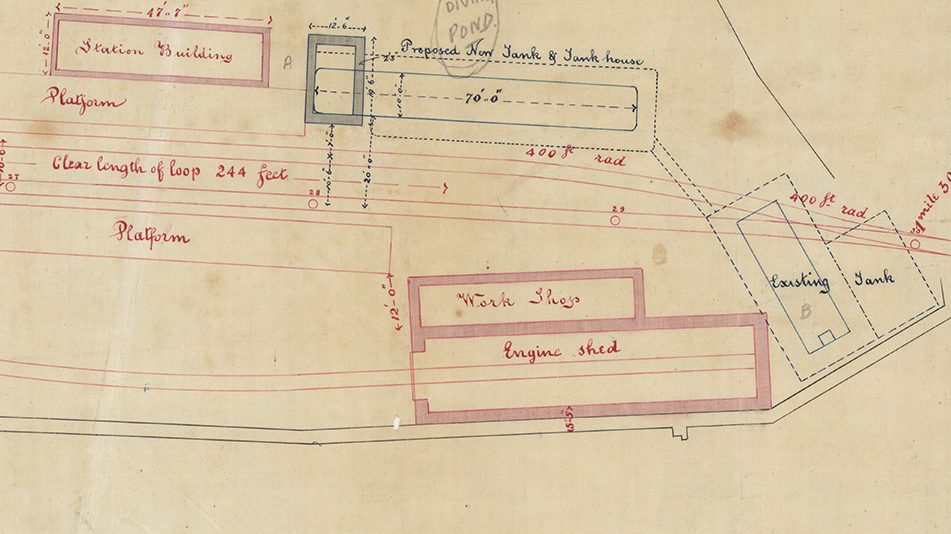
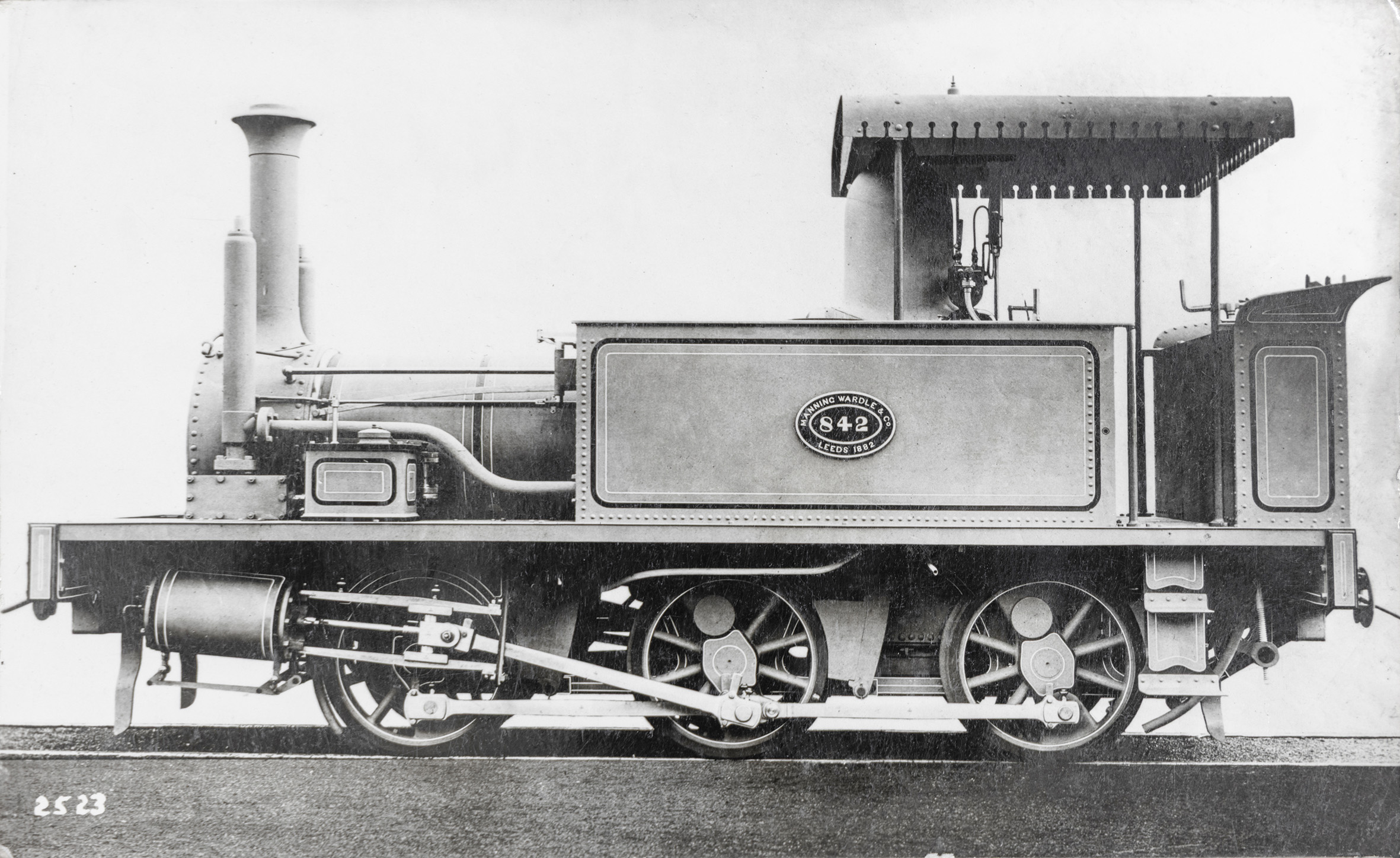
Tom explained that the railway had no workshop at the time, Horne’s shop providing facilities for maintenance of locomotives. He mentions transporting engine No.4 to his works and dismantling it there but makes no note of where business was carried out, though it’s likely that it was around Marsa. He says that the boilers of the other two Manning Wardle designed locomotives, 2 and 3, were taken to the Naval Dockyard workshops.
It was implied that this was all engineered to bring about the forfeiture of the railway to Government. Further accusations of corrupt practices arise from Gatt’s acquisition of the railway rollingstock and locomotives at auction at knock-down prices.
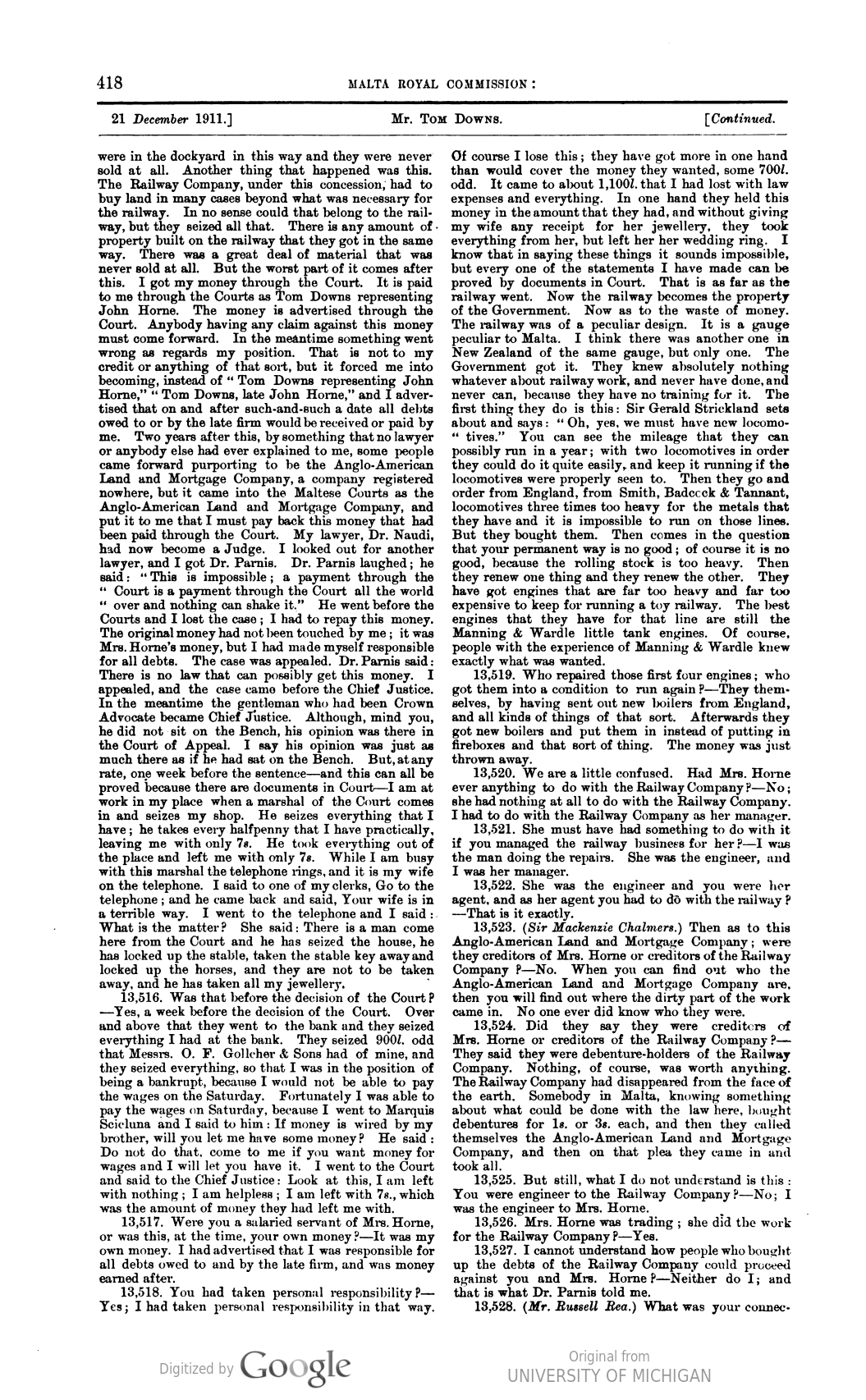
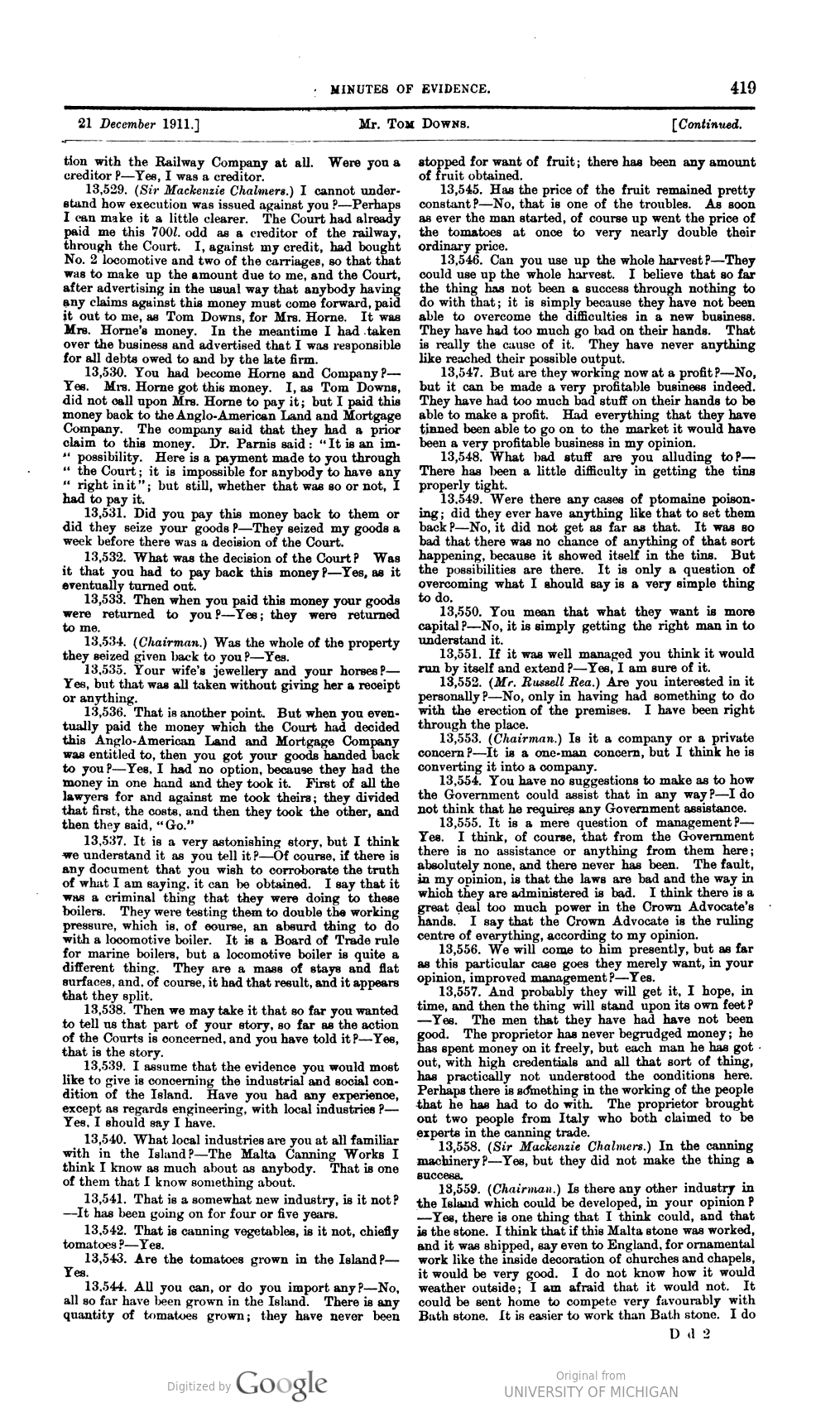
Tom was certainly one of the creditors to the Company. He eventually made legal claim for what the business was owed. He declared he’d seized, or had impounded, engine No.2, then still at the dockyard, and two carriages, the value of which he considered made up what was due to him.
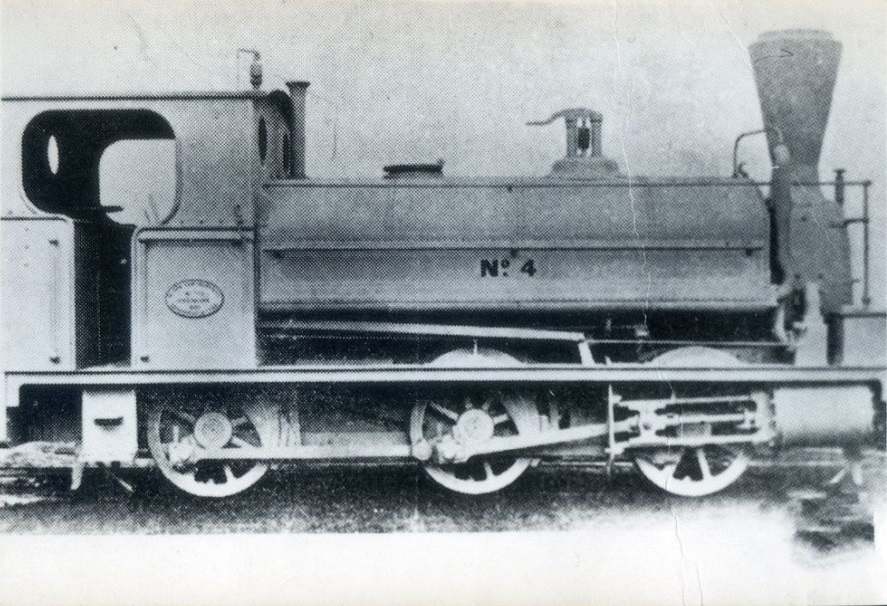
There’s some confusion here. Tom’s testimony is somewhat convoluted and disjointed. Was Engine No.4 still in his workshops? He says No.2 was never part of the auction set up to liquidate assets. He also says he was trying to bid on auction lots, but they were not knocked down to him because there was no competing bidder.
Assets were clearly scattered, with creditors’ claims to various engines and rollingstock unclear, but it seems that Tom’s claims resulted in the Maltese Courts granting him £700 against the value of his seized assets.
Two years later he says the Anglo-American Land and Mortgage Company (AAL&MCo) came in search for its own money. It had sold the old Railway Company debentures which gave them preferential claims to assets on default of interest payments. As such, the Maltese Courts had no lawful grounds to have made any award to any creditor before them. The courts instructed the repayment of money from creditors and redirected it to the AAL&MCo.
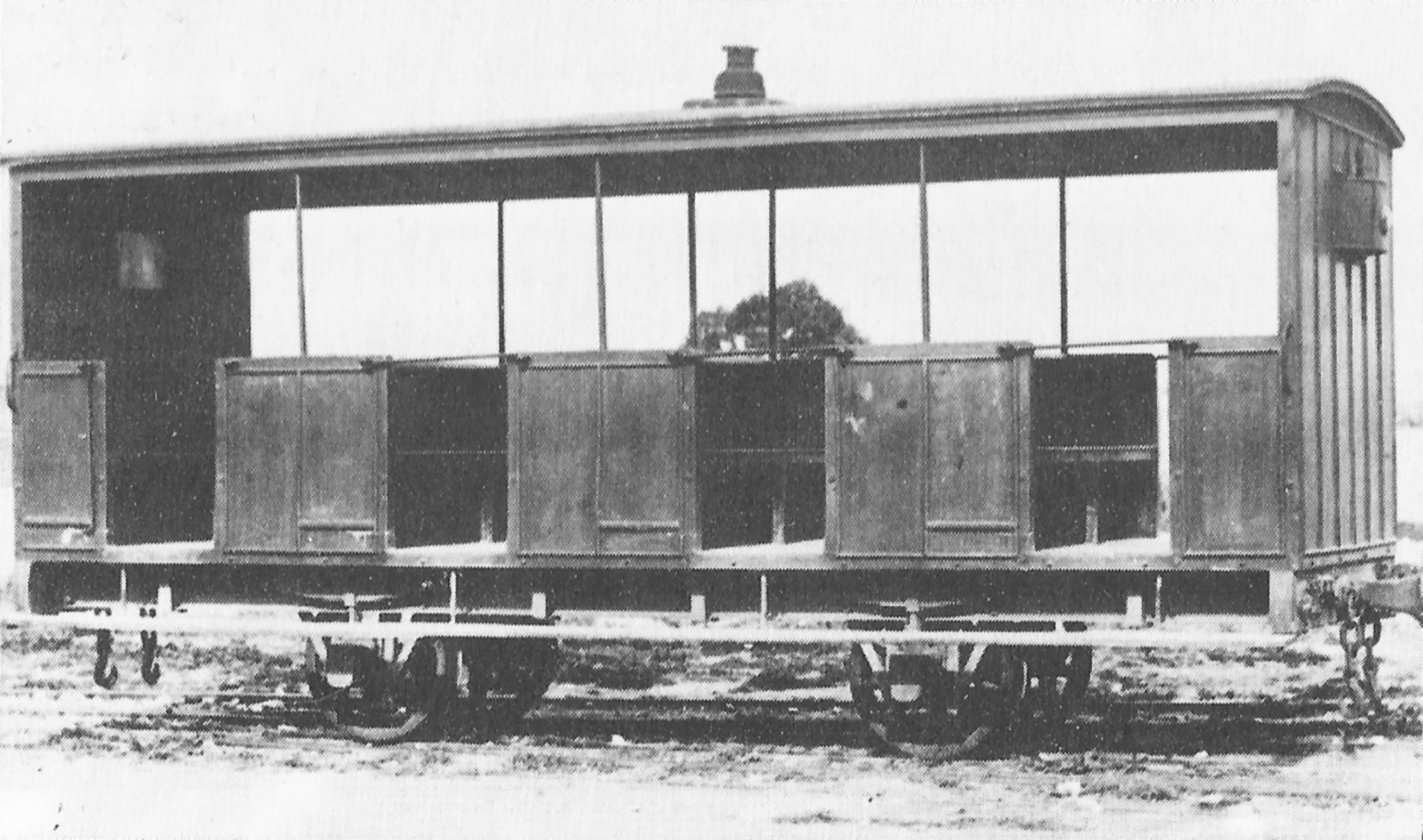
Tom, understandably aggrieved, claimed wrongly that the AAL&MCo was “somebody in Malta, knowing something about what could be done with the law here, bought debentures for 1s. or 3s. each, and then they called themselves the Anglo-American Land and Mortgage; Company”, that it had no registered address and was set up to exploit Maltese law and the collapse of the railway company.
Claims of unfair seizure of railway land by Government were also made by Tom, but this can only be considered anecdotal as he had no direct experience of the matter and is unlikely to have known the exact terms of the concession. The subsequent part of his evidence on the railway relates to what he saw as mismanagement following public ownership. Some of these claims are quite mistaken.
He claimed that the railway gauge was peculiar to Malta. He acknowledged that here might also be another railway in New Zealand that was also metre-gauge “but only the one”. He stated that the Sir Gerald Stickland’s purchase of two new engines from “Smith, Badcock & Tannant” was poorly informed, that they were three times heavier than the rails could take, and that the new engines were “far too expensive to keep for running a toy railway”.
He claimed the purchase of new boilers to bring the old engines back into use “was money was just thrown away” when repairs and less extensive replacements were, in Tom’s view, more proportionate.
To what extent was Tom Downs a reliable witness? He was reciting events to the Commission that had happened over twenty years previously. The length of time passed is the first consideration here; although Downs refers to documents that support his version of events a considerable time had elapsed, and memories are likely to be blurred.
Downs was from an engineering family. They were partners in Rose, Downs and Thompson of Hull, engineers, millwrights, boiler makers, and founders. It was here he conducted his apprenticeship before taking over management of a Grimsby firm. He no doubt had a great deal of practical experience but was not part of the formally educated class of professional engineers, or member of the Institute of Civil Engineers.
Although he seemed forthright in giving evidence on the railway there are many inconsistencies, particularly in the timeline he suggested and some of the details of the last years of the line.
George Buchanan was a civil engineer and member of the Institute, but probably also a shareholder in the railway company. His presence in Malta was likely as company representative, perhaps director, rather than as a permanent general manager. This would explain his short time on the island.
It’s likely that Buchanan hired Downs to put the railway in working order in1888 and that Downs exhausted much time in that commission. It’s not clear under what terms he was engaged.
In 1888 Government commissioned the dockyard Inspector of Machinery and Chief Engineer to inspect the condition of the engines on behalf of the Railway Board. It’s not clear when in the year this was done, but the need to make urgent repairs may have been the reason for Down’s engagement. The report identified:
- No.s 1 & 3 boilers unfit for use
- No. 2 required a 5-week repair
- No.4 was in a fair condition
Downs fails to mention the well-documented accident where engine No.4 exploded in Floriana tunnel in March 1889, or that the Government’s new law was introduced two months later, in effect from 2nd May 1889, probably in part a response to that incident. Nor does he mention the scope of the law which required only that boilers were made available for Government inspection by an appointed person and empowered access to do so; it prescribed no criteria for tests.
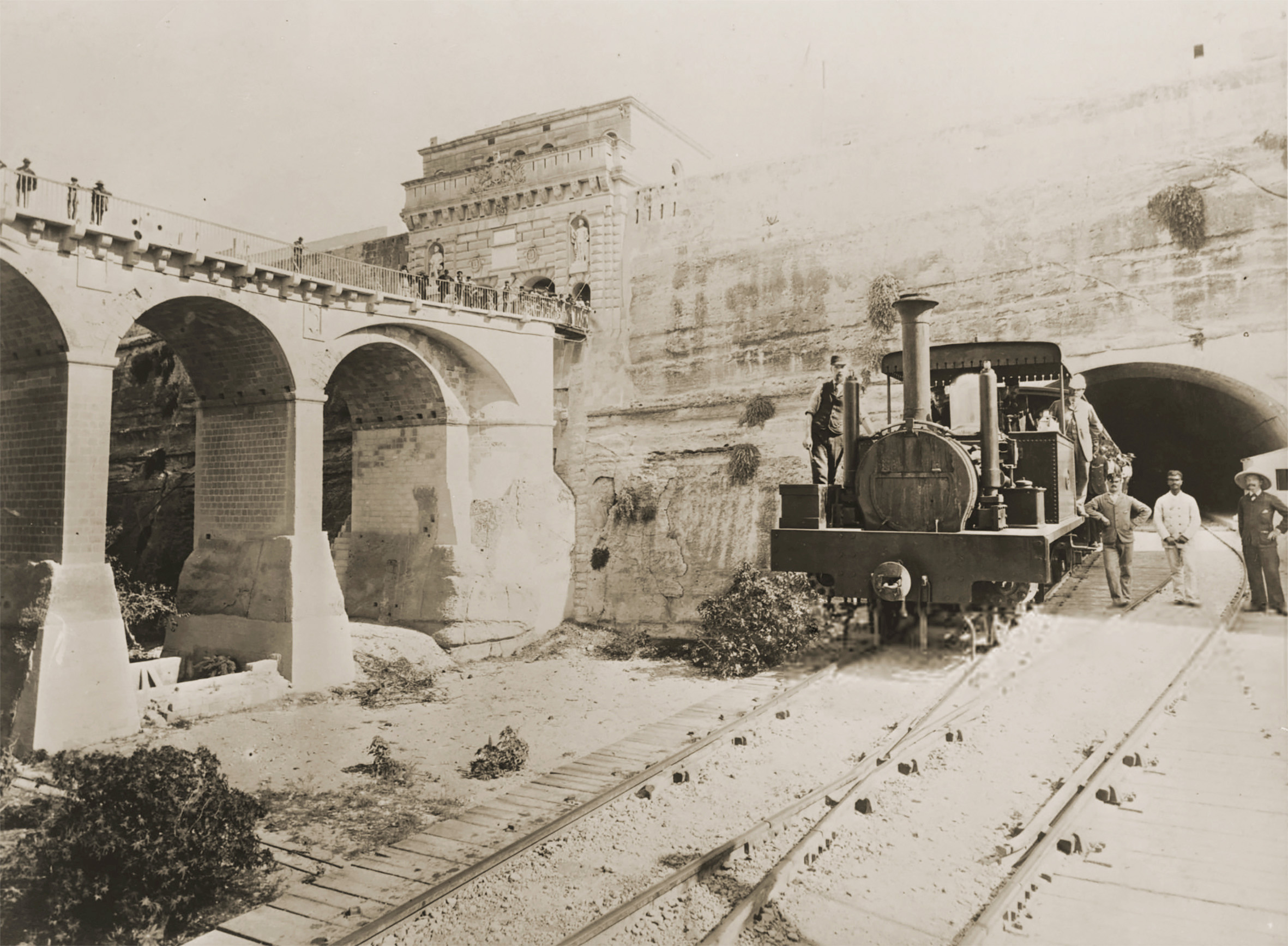
Downs sets out that Government instructed tests on engine No.1 under this new law and they were responsible for its failure before No.4 suffered similar damage under the same tests. He was only present at the first, by his own account, but neither of these incidents could have taken place before the enactment of the new law, which paradoxically only happened after No.4 was already out of operation.
It’s possible that Downs was confused, and it had been the 1888 dockyards tests that had resulted in damage to No.1, perhaps where the assumption arose that it had been overstressed by the application of maritime boiler standards. This explanation would fit with the short period Buchanan was in charge in 1888 and Downs recommendation to him of a steel firebox to replace No.1’s. However, Downs doesn’t account for the report of the same unfit condition of No.3s boiler at the same time.
George Buchanan was an experienced, capable, and accredited engineer in his own right, far beyond the knowledge and hands-on experience of a youthful Downs. It would be extraordinary for him to have accepted testing that he knew would destroy the boilers and, if a shareholder, would have been protective of his investment. Downs’ timeline would have seen Buchanan accept destructive testing on Company assets and have had no apparent agency in the matter. Downs claimed it was him that raised objections directly with Gatt, but as General manager, accredited engineer, or Company representative, why would Buchanan have delegated this to a junior contractor?
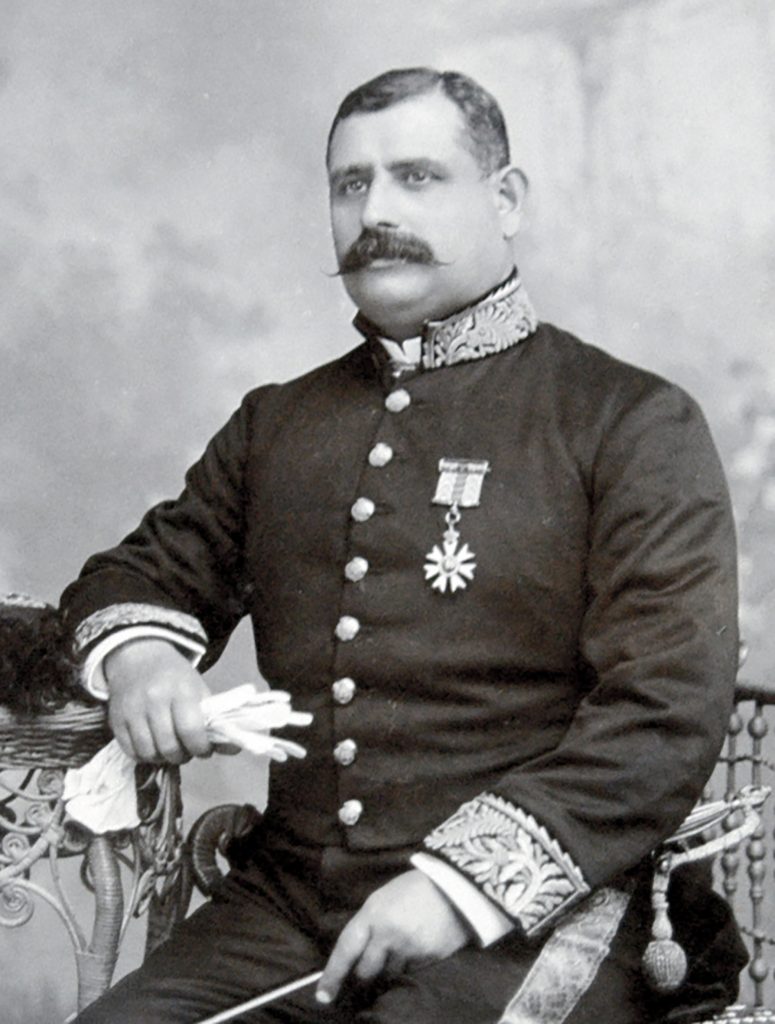
Downs says he had No.4 in his workshop in a dismantled condition with a damaged firebox and said it was irreparable without copper, which he could not secure. This could have been a result of the explosion in the tunnel in March 1889, but Downs would need to have been very confused to ascribe this damage to excessive pressure testing under the Government regime. The engine was reported in fair condition in 1888 after testing by the dockyard chief engineer, but apparently not repaired between the tunnel incident and before Government took over in 1890; it could not have been subject to the new testing law; Downs must be mistaken
Downs evidence makes no note of the next railway General Manager, J. C. Gilbert, who, based on his account, likely arrived shortly after Buchannan’s departure. Downs implies that he was given authority by Buchanan to manage the railway on his departure, but in reality, Gilbert would have formally assumed that role during the final desperate year. As his contractor, Gilbert had no obligation to keep Downs informed of everything happening behind the scenes.
History suggests that the Maltese Government gave considerable leeway to the railway Company before executing the contractual clause to seize the railway. In 1889 it even deferred fines it should have levied on the company for failing to meet its contract, instead committing almost £400 to pay for the repair of boilers of locomotives No.2 and 3 languishing at the dockyard for the Company to maintain a service. That the dockyard was able to carry out this work conflicts with Downs’ claim that they were only able to procure materials for their own use and couldn’t undertake outside work. This suggests that it was more the case that the Railway Company simply couldn’t afford the work and concealed the truth.
It would not have been in the Company’s interests to let creditors know its financial state. Gilbert’s negotiations with Government as general manager and with the Company’s Solicitors would jeopardise the company’s future even further if the scale of their debts became widely known. Downs was unlikely to be told that his investment of time and materials was at risk when they still relied on him to undertake maintenance. Whilst his loyalty to the Company might be laudable, some of his statements to the Commission were likely made in ignorance of the bigger picture.
When Downs’ own Solicitors advised him of his position, he laid claim to Company assets to cover his expenditure. This is corroborated by legal papers, though his account given to the Commissioners that he ‘purchased’ engine No.2 and two carriages against his debts is suspect. In their history of the railway, Bonicci and Cassar write “A certain Mr Downs had impounded cars numbered 18, 19, 20, 21, engine No. 2, three ballast trucks and four platelayers’ trolleys.” The difference in the scale of these claims is unaccountable.
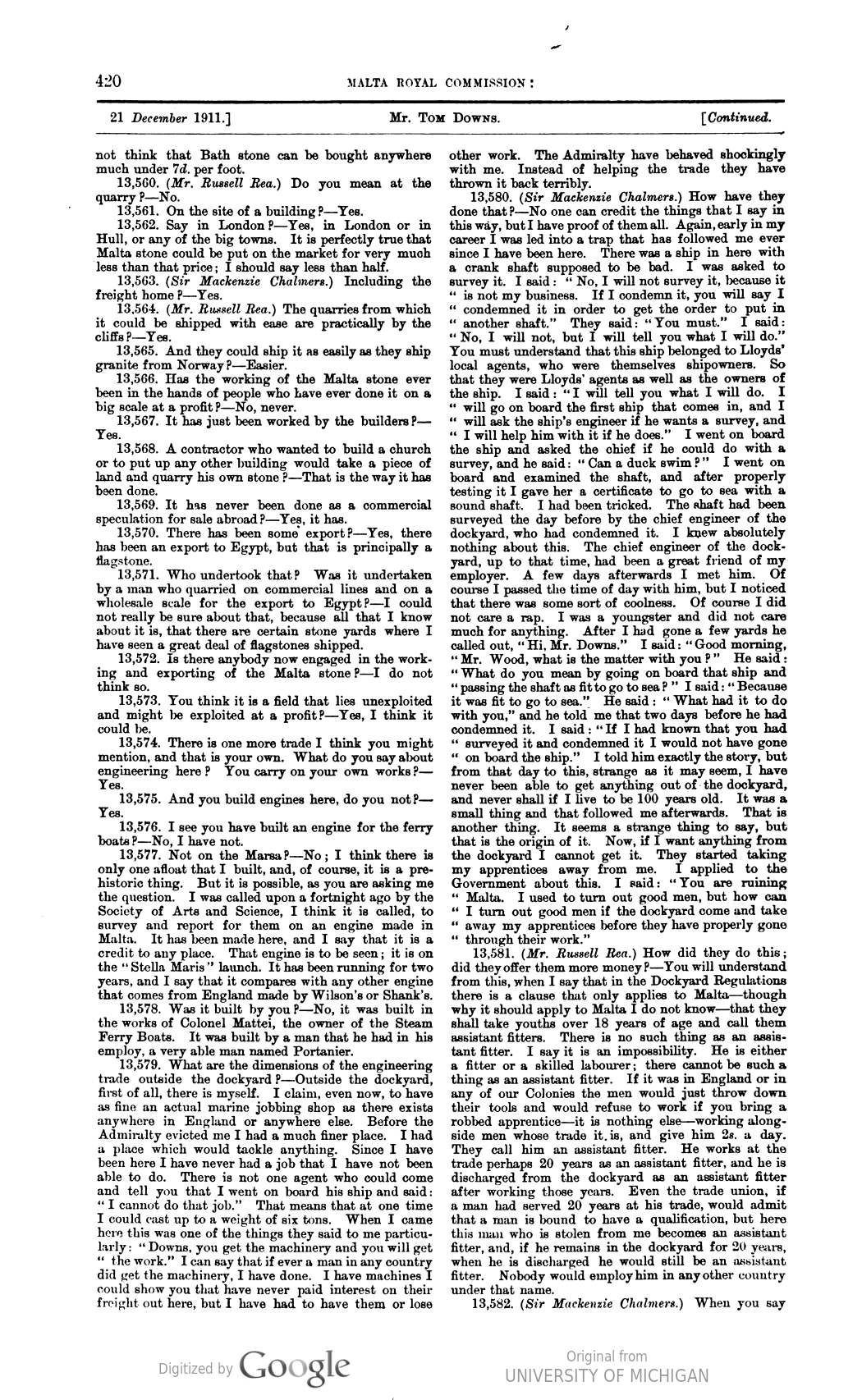
It’s clear he harboured grievances over how he thought he had been treated by Government over the matter of the railway forfeiture, and by the Courts in their management of the liquidated assets. In later evidence he claimed he’d been badly treated by the Admiralty too, in business dealings with them and having been evicted from workshops he used in the dockyards twice. He also complained that his apprentices were poached by the Naval dockyard. He clearly had axes to grind with officialdom.
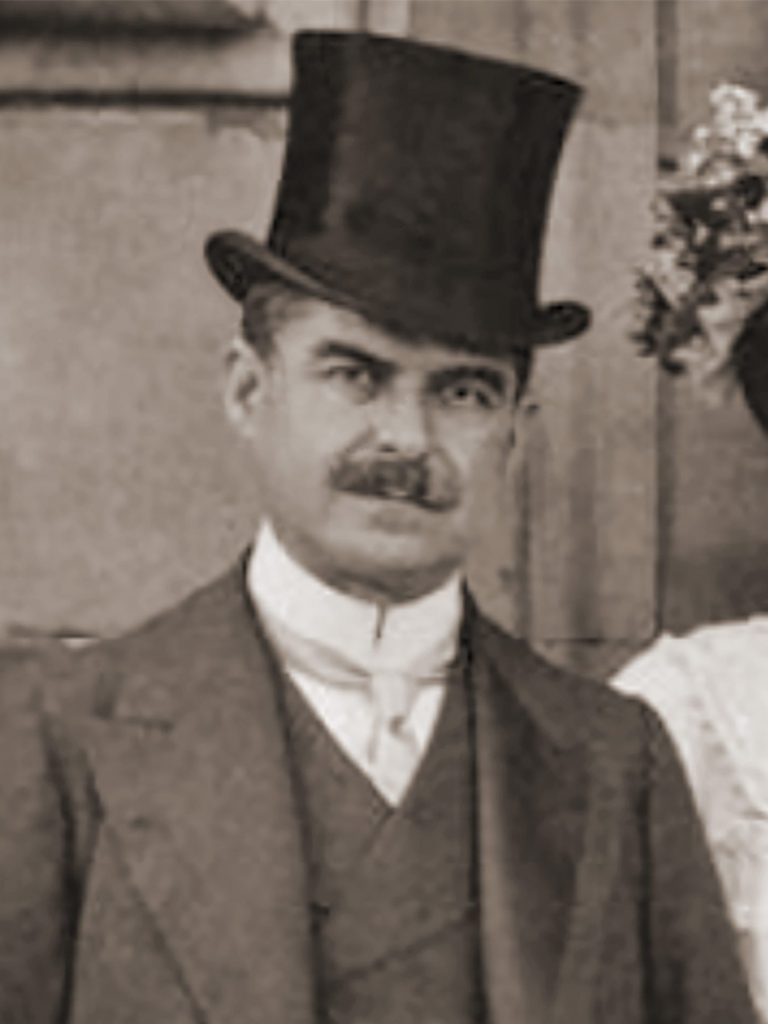
The tone taken in the Commission transcripts is aggressive and accusatory, particularly against people who he felt had injured him or his business. He clearly implies both Strickland and Gatt are incompetent or corrupt in their handling of the railway as well as other undertakings. He makes his opinion felt that Government colluded in the collapse of the Railway Company and the contrived seizure of its assets for their own benefit.
Downs expresses his own confidence in his knowledge, skills, and ability in later evidence. He states he has never needed to decline any work through a lack of these attributes. He is proud; This self-acclaim as an engineer is somewhat undermined by some of his statements.
As an engineer with railway experience, it might be expected he’d be aware that the use of metre gauge railways was widespread and global. There were innumerable lines operating across the British Empire at the time. By 1911 there were at least 45 individual metre-gauge networks in India alone. His claim that it was peculiar to Malta and one perhaps in New Zealand is entirely unfounded.
In criticizing Strickland’s investment in two new locomotives, he states these were procured from “Smith, Badcock & Tannant”. This is conceivably a mistype in the transcription for the Leeds-based company Smith, Beacock and Tannett, but they were machine tool manufacturers and did not make railway engines.
The company who had supplied these new engines was Manning Wardle Co Ltd, the same company who supplied the original three locomotives. They had been operating on the Malta Railway for a decade before the Commission was convened, and it’s extraordinary that Downs would have made such a basic error in his testimony.
By the time of the Commission, it was widely acknowledged that the engines were too heavy for the rails. Downs claim they were three times the weight was pure exaggeration. They were a little over twice the weight of the original engines, but far from the 51 tons Downs asserted.
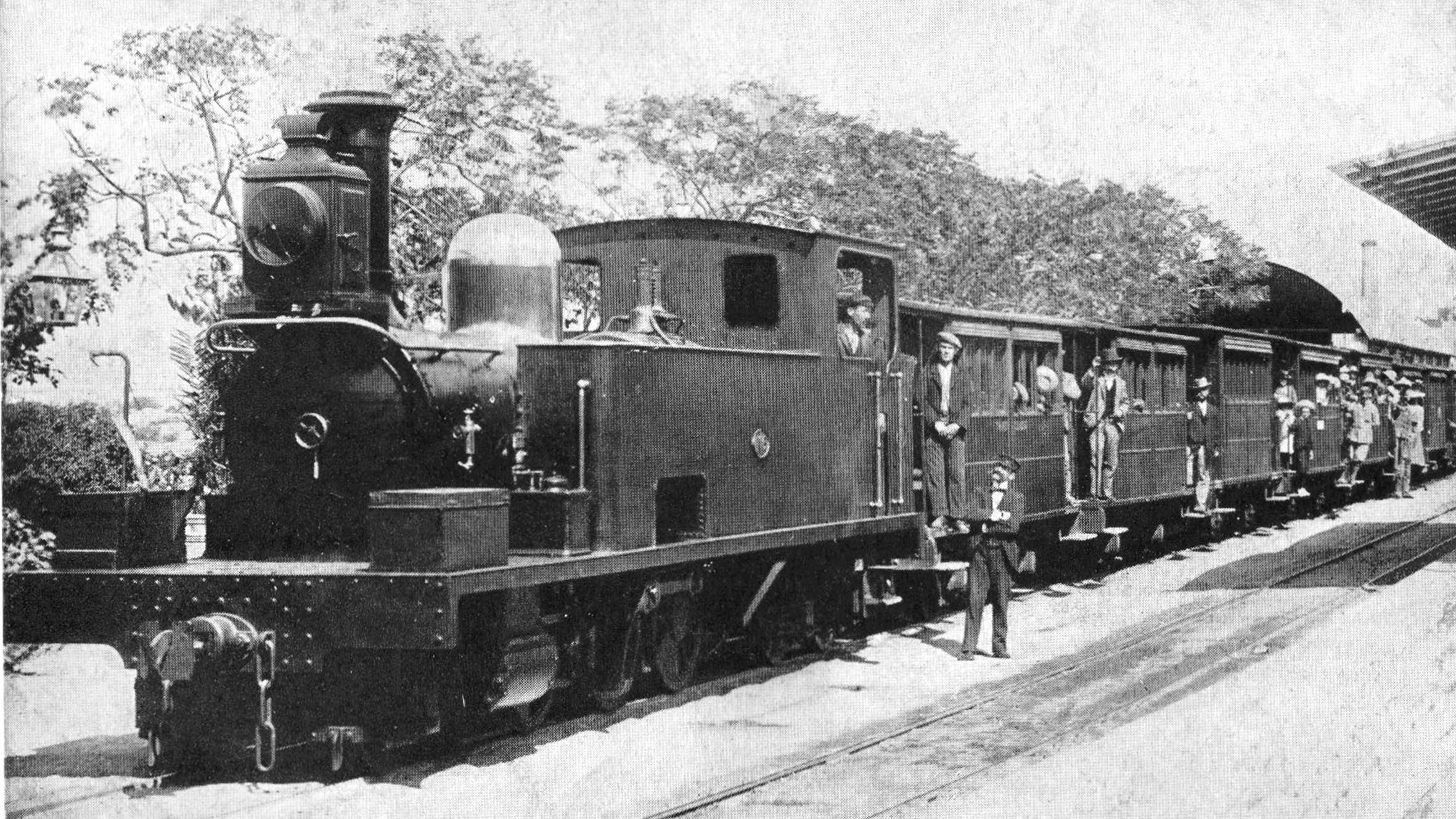
His implication that Strickland ordered these with no regard to the loading on the track is also unfounded, considerable investment being made in upgrading the railway before their arrival. Damage to the track did result, but this was attributed more to the weight distribution of the engine design.
Downs also exposes a degree of ignorance on Government’s repair of the original engines. On taking possession, they were all repaired at the dockyard; This is exactly what Downs states had not been done. The uniquely peculiar boiler of No.4 had to be sent back to the UK for repairs.
It was only after 1893 that entirely new boilers were gradually introduced. Whilst later locomotives had boilers replaced on a fifteen-year cycle, the abuse and repeated repair the original engines had undergone would likely have accelerated the process; in this instance ten years would not seem outlandish.
Downs clearly felt victimised, targeted by the authorities and actively excluded from Government contracts. His evidence given to the Commissioners in 1911 can’t be considered as objective or reliable, as much for the time that had elapsed since events transpired as for the factual inconsistencies. It does, however, add a degree of insight into the alarming condition the railway was left in for its final two years.
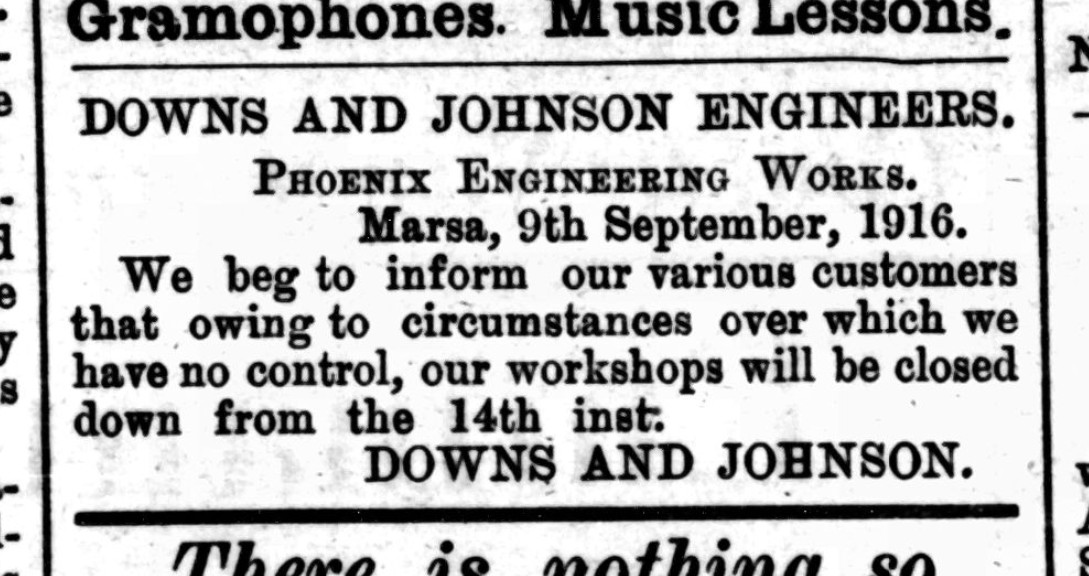
He continued business with the Phoenix Engineering Works on modern-day 29 Triq Hal Qormi, Marsa, though the exact location can’t be located. Latterly he was in partnership as Downs & Johnson, but the business was closed down on the 14th of September 1916 with a brief notice in the papers that it was “owing to circumstances over which we have no control”. Downs and his family returned to the UK.
He retired to Barton-on-Humber near Hull where he became well known for his interest in athletics, one obituary from 1935 noting, in his youth, that “in several forms of gymnastics he was recognised as one of the best performers in the North of England” despite having “been a cripple from childhood”.
A full copy of the whole Royal Commission minutes can be found here. Pages relevant to Tom Downs’ evidence of the railway follow below.

No responses yet